
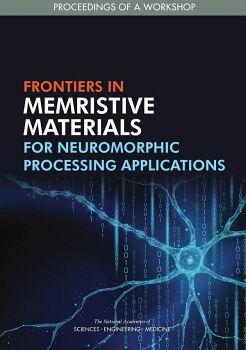
 FRONTIERS IN MEMRISTIVE MATERIALS FOR NEUROMORPHIC PROCESSING APPLICATIONS
FRONTIERS IN MEMRISTIVE MATERIALS FOR NEUROMORPHIC PROCESSING APPLICATIONS
FRONTIERS IN MEMRISTIVE MATERIALS FOR NEUROMORPHIC PROCESSING APPLICATIONS
 Impresión bajo demanda
AA.VV
Tiempo de despacho de pedidos es de 15 a 20 días hábiles, una vez confirmado el pago del pedido.
Current von Neumann style computing is energy inefficient and bandwidth limited as information is physically shuttled via electrons between processor, short term non-volatile memory, and long-term storage. Biologically inspired neuromorphic computing, with its inherent autonomous learning capabilities and much lower power requirements based on analog processing, is seen as an avenue for overcoming these limitations. The development of nanoelectronic "memory resistors", or memristors, is essential to neuromorphic architectures as they allow logic-based elements for information processing to be combined directly with nonvolatile memory for efficient emulation of neurons and synapses found in the brain. Memristors are typically composed of a switchable material with nonlinear hysteretic behavior sandwiched between two conducting encoding elements. The design, dynamic control, scaling and fundamental understanding of these materials is essential for establishing memristive devices. To explore the state-of-the-art in the materials fundamentally underlying memristor technologies: their science, their mechanisms and their functional imperatives to realize neuromorphic computing machines, the National Academies of Sciences, Engineering, and Medicine's Board on Physics and Astronomy conveneda workshop on February 28, 2020. This publication summarizes the presentation and discussion of the workshop.
 Impresión bajo demanda
 Impresión bajo demanda
 Impresión bajo demanda
 Impresión bajo demanda
 Impresión bajo demanda
 Impresión bajo demanda