 Impresión bajo demanda
Tiempo de despacho de pedidos es de 15 a 20 días hábiles, una vez confirmado el pago del pedido.
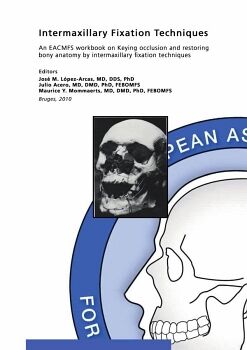
Many of the conventional arch bars or wiring techniques were developed at a time when most facial fractures were treated by intermaxillary fixation (IMF) only and therefore had to be sufficiently stable to maintain immobilisation for a prolonged period.Since the introduction of open reduction and rigid osteosynthesis (ORIF) protocols, IMF has been predominantly used to obtain normocclusion during the surgical procedure or for a short period postoperatively for support using rubber bands. In some cases, IMF bone screws may be sufficient. Consequently, the indications for using simpler IMF systems are increasing.There are still situations in cranio-maxillofacial (CMF) trauma in which stable IMF using conventional arch bars with circumdental wire fixation is necessary. These conditions include nonoperative treatment of displaced condylar fractures and final occlusal adjustment using guiding elastics after open reduction internal fixation (ORIF) for comminuted mandibular fractures and displaced fractures of the maxilla. Other situations include partially edentulous jaws where it is difficult to find a proper relationship between the dental arches when treating a complex fracture and in certain cases of bony reconstruction following tumour resection. In these situations, IMF using bone screws or arch bar fixation using direct bonding techniques tends to be unstable or even impossible to carry out because of the lack of teeth and occlusion.The purpose of this manual is to show the surgeon-in-training the IMF techniques that are currently available as well as the classic wiring techniques that can be helpful in certain circumstances.PALABRAS CLAVEIntermaxillary fixation; mandible fractures; facial osteosynthesis; facial trauma; dental trauma.
 Impresión bajo demanda
 Impresión bajo demanda
 Impresión bajo demanda
 Impresión bajo demanda
 Impresión bajo demanda
 Impresión bajo demanda